
Sentinel User Preparation and organic Carbon from earth Observation between Ocean and Land (SUPaCOOL)
Preparing users for next-generation CHIME and LSTM satellite missions to monitor organic carbon flux in coastal waters and river plumes-closing critical gaps in global carbon cycle understanding.
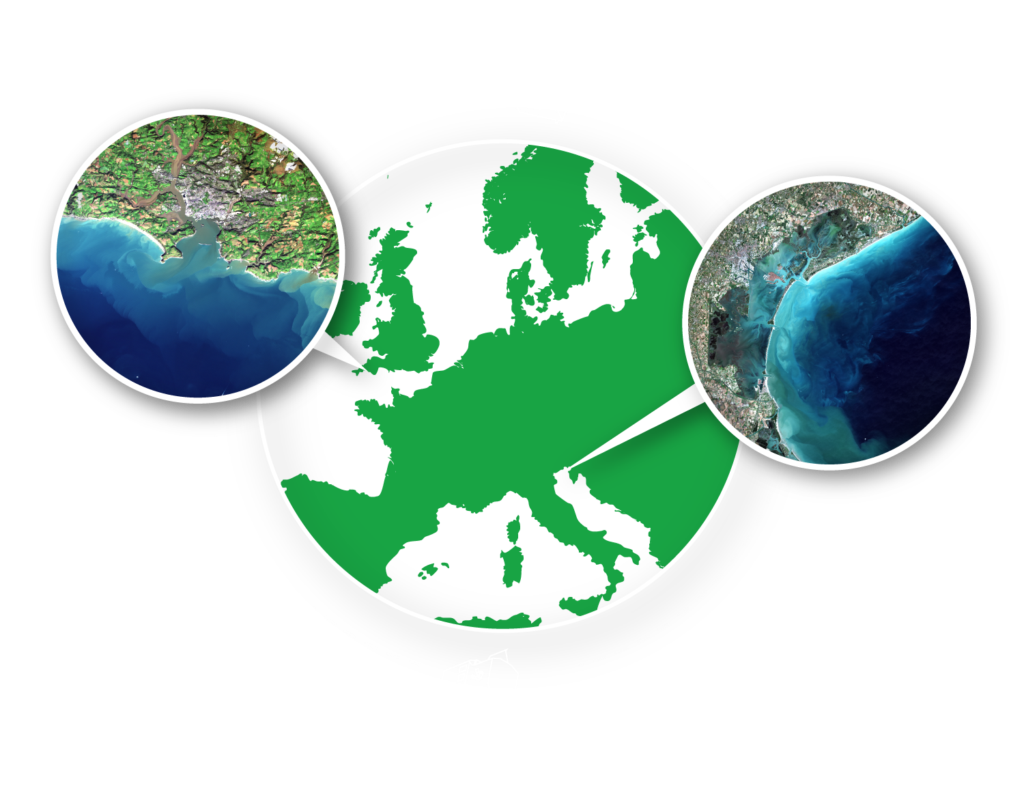
The project is a complementary study to the Carbon from earth Observation between Ocean and Land (COOL) project. In order to take advantage of the next generation of Sentinel satellites working in synergy, it will focus on a high spatial resolution investigation of the inner-mid-outer river plumes, where SUPaCOOL will generate a reference open dataset to allow for development and testing of algorithms addressing a significant, and challenging gap in the knowledge of carbon cycle around river plumes.
Impact & Applications
SUPaCOOL’s advances will improve carbon cycle models, support EU environmental policies (Water Framework and Bathing Water Directives), and contribute to future Copernicus Water Service development. By maximizing synergies with ESA initiatives like SCOPE, COOL, and HyperBOOST, it will produce step-change improvements in coastal carbon monitoring at scales critical for understanding the global climate.
Sentinel Expansion missions
The upcoming Sentinel Expansion missions – CHIME and LSTM – will significantly boost Europe’s ability to monitor coastal environments, especially for tracking carbon. CHIME will provide high spatial and hyperspectral data on land and coastal waters using advanced hyperspectral imaging, while LSTM will deliver high-spatial resolution temperature measurements for land and sea surfaces. Together, these missions will give us an unprecedented view of coastal ecosystems, helping to track changes caused by natural processes such as tides and river outflows.
CHIME Mission
Advanced hyperspectral imaging providing high spatial resolution data on land and coastal waters. Enables detailed tracking of phytoplankton assemblages and organic carbon distributions across river plumes.
LSTM Mission
High-resolution sea surface temperature measurements matching CHIME’s spatial scale. Critical for understanding thermal gradients that drive carbon transformation in estuarine mixing zones.